I caught myself doing it again last Tuesday. A question landed in my inbox, the kind that needs an actual answer and not a reflex, and before I'd finished reading it my hand was already in a new tab, already half a sentence into a prompt. I hadn't thought about the problem yet. I was going to let something else do that part.
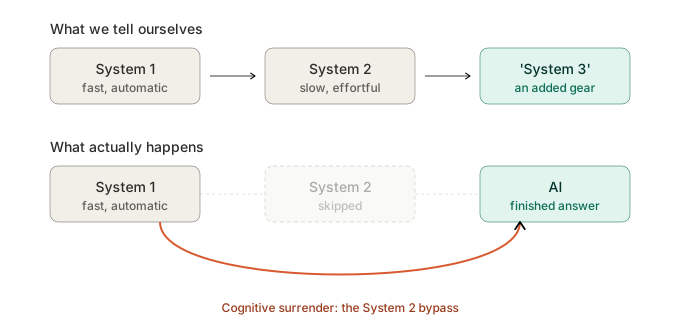
It felt like efficiency. It mostly does. But there was a half-second where I watched the move happen, and the move was: skip the thinking, go straight to the output. Not "think alongside the machine." Just hand the thinking over and wait for it to come back. I closed the tab and sat with the question for ten minutes like some kind of caveman. The answer I got to was better than the one I'd have shipped. That's the part that bothers me, because I nearly didn't bother to find out.
I've heard this described as cognitive surrender. Not the dramatic kind, where you knowingly give something up. The quiet kind, where you hand over the thinking before you've even registered that there was any thinking to be done. I've spent a decade watching a version of it arrive in different clothes. We called it the feed, or the algorithm, or screen time, or the attention economy. We worried about all of it, and we were right to. But I've started to think we were guarding the wrong border. Social media came for our leisure and turned us into spectators of the world. The thing arriving now isn't interested in our leisure. It's interested in the part of us that does the work.
The most expensive organ you own
Start with the body, because the body explains most of this before psychology gets a word in. Your brain is roughly 2% of your body weight and burns about 20% of your energy while you sit there doing nothing. It is the most expensive thing you own to keep running, and evolution has never been sentimental about expensive things that fire up when they don't strictly have to.
So we economise. Psychologists have circled this for the better part of a century. Hull called it the "law of less work" in 1943, describing animals taking the path that cost them the fewest calories. Later the same idea got pointed at thinking and renamed the "law of least mental effort": all else being equal, the brain reaches for the cheapest route to a goal. We are, in a phrase from Fiske and Taylor that I've never been able to shake, "cognitive misers." In a now-classic set of experiments, Wouter Kool and his colleagues gave people two tasks that were identical except for how much mental switching they demanded, controlled for time and reward and everything else, and people quietly, reliably chose the lazier one. Effort with no other downside attached was enough on its own to put them off. The brain prices hard thinking as a cost and marks down the reward to avoid paying it.
There's a wrinkle, though, and it's the wrinkle that makes everything that follows possible. We don't only avoid effort. We also can't tolerate boredom. Leave a person with nothing to do and they will reach for the nearest scrap of stimulation, sometimes an actively unpleasant one, just to make the emptiness stop. So the real setting we run on is narrower and stranger than plain laziness. It's closer to: avoid effort, but never sit still. Find me something that feels like engagement without charging me for it.
That is a very precise vulnerability. It also turns out to be one of the great business opportunities in human history.
What the feed was actually training
The trick of social media was never the content. It was the discovery that you could feed both halves of that instinct at the same time. Constant stimulation, almost no effort. The pull to refresh, the variable reward, the autoplay that starts the next thing before you've decided you want it: that's slot-machine grammar, and none of it is accidental. You don't have to do anything. You don't even have to choose. The feed chooses, and you watch.
The currency underneath all of it is dopamine, which everyone now name-drops and almost nobody describes correctly. It isn't the pleasure chemical. It's the anticipation chemical, the one that fires for the reward you might be about to get, which is exactly why unpredictability is the engine and not a side effect. A reward you'll definitely receive is boring. A reward you might receive keeps you pulling the lever. The feed runs entirely on maybe. Every refresh is a maybe, every notification a maybe, and the body will chase a maybe for hours after it has stopped enjoying itself. So "instant gratification" turns out to be the wrong name for the thing. It was never the gratification we got hooked on. It was the gap right before it.
What we lost in that exchange wasn't intelligence, and I want to be careful here, because the "phones are melting our brains" version of this argument is lazy and mostly wrong. We didn't get stupider. We got impatient. The thing that thinned out was tolerance: the capacity to stay with something boring or difficult long enough for it to turn into something good. We trained most of a species to bail at the first dip in stimulation, because there was always a richer hit waiting one thumb-flick away. Why sit in the discomfort of a half-formed idea when the feed will hand you a fully-formed feeling for free?
And we slid, without really clocking it, from the active voice into the passive one. From making things to watching things. You end up with a lot of people who can recognise quality without being able to produce it, who can feel when something is good but have lost the patience to build something good themselves. Spectators. I don't say that with any superiority. I'm describing myself on a tired Sunday evening as accurately as anyone.
But notice where the damage stayed. All of it happened inside the zone we'd already fenced off and labelled leisure. The cost was real, but it was contained to how we rest and scroll and kill the gaps in the day. Work was meant to be the room where the effort still lived. The place the spectator had to stand up and become a participant again.
Except the spectator didn't stay in the lobby. I watch it now in meetings, in the way people receive a strategy instead of arguing with it. A deck lands, heads nod, nobody really fights it, and you realise the room has started treating ideas the way it treats the feed: as content to be consumed rather than work to be done. The posture we learned on the couch followed us to the desk years before any model did. The machine isn't introducing the passivity. It's pouring accelerant on a fire we lit ourselves.
System 1, System 2, and whatever we're calling the third one
Kahneman handed us the shorthand and it has earned its keep. System 1 is fast, automatic, intuitive: the part that reads a face, catches a ball, finishes a familiar phrase without any sense of trying. System 2 is slow, deliberate, expensive: the part that does the long division, weighs a genuine trade-off, holds two contradictory ideas still and side by side long enough to actually compare them. System 2 is the effortful one. It's also where most of what we'd honestly call judgment is forged.
Lately people have taken to calling AI "System 3," as though it were a new gear bolted onto the same engine. I get the appeal of the phrase. But I think it flatters us. A genuine third system would add capacity. What's actually on the table is a way to route around the second one without ever switching it on.
The brain treats thinking as a cost to be minimised. AI is the first tool good enough to let it win.
That is the line I keep stopping on. Social media found the bypass around our attention and got rich. AI has found the bypass around System 2, and it has arrived wearing the uniform of a productivity tool, which means we will usher it straight through the front door of the office and offer it a desk. The feed colonised the couch. This moves into the work itself: the analysis, the first draft, the synthesis, the call you make when the data is ambiguous and someone has to decide. The exact muscles we promised ourselves work would keep in shape.
You can see the handover if you look for it. The strategist who asks the model what the strategy should be. The analyst who pastes in the chart and asks what it means, instead of the other way round. The writer who generates three directions and picks one, never having held a direction of their own. None of these people are lazy, and none of them are stupid. They're doing precisely what the most expensive organ they own has always wanted to do, which is find the version of the task that costs the least. The tool simply made the cheap path also the fast path, and then, worst of all, the respectable one. That's cognitive surrender in its ordinary form, and the reason it's so hard to resist is that it never once feels like surrender.
And it feels wonderful, in precisely the way the feed felt wonderful. Frictionless. A finished thought with none of the cost of having had one. The least-effort animal, finally handed the instrument it has been waiting for since it first learned to dodge the harder of two card decks. This is the move from entertainment to intelligence, and we are sleepwalking into it with the same expression we had scrolling at midnight. The difference is that this time the thing we're handing over isn't an evening. It's the capability we sell.
The bill arrives later
We already have an early reading of what the trade costs. Last year a team at the MIT Media Lab ran a study with an admirably blunt title, "Your Brain on ChatGPT." They split 54 people into three groups and set them to writing essays: one group using a large language model, one using a search engine, one using nothing but the head they came in with. Everyone was wired to an EEG so the researchers could watch the machinery while it ran.
The brains told a tidy story. The unaided writers lit up the widest, most densely connected networks. The search group came in lower. The AI group showed the weakest connectivity of the three. The AI writers also reported the least sense of ownership over what they'd made, and a striking number of them couldn't quote a single line back from an essay they had "written" minutes earlier. The researchers gave the effect a name that has stuck with me: cognitive debt. You borrow the effort you skip today, and the interest arrives later, as skill you never actually built. They ran it over four months and the pattern held. The convenience showed up every single time. The cost was invisible every single time, right up to the moment you asked someone to do the thing on their own.
This is the part that keeps me up, and it lands squarely in my world, not a neuroscientist's. I run content and digital experience for a living. My field is full of people whose entire value is judgment: knowing when a piece is right, when a structure holds its weight, when a strategy is quietly kidding itself. Nobody was ever taught that in a slide deck. They earned it, by doing the work badly a few hundred times until taste slowly precipitated out of the repetition. AI is genuinely excellent at the easy 80% of that work, which happens to be the exact 80% that used to be how a junior built the muscle in the first place. So we are about to produce a cohort of people who can summon a competent answer in nine seconds and have no felt sense of whether it's any good.
I've started seeing the early shape of this in review. A piece comes in clean, well structured, confident, and completely hollow, and the person who made it can't tell, because they didn't really make it. They commissioned it and tidied the seams. The errors aren't the kind a spellcheck catches. They're errors of judgment: the wrong frame, the safe and pointless angle, the claim that sounds true and isn't. Those are exactly the errors you only learn to catch by having committed them yourself, slowly, with your own name on the draft and your own embarrassment attached. Strip out the slow part and you strip out the apprenticeship along with it. We used to call the easy 80% "paying your dues." It's starting to look like the dues were the curriculum, and we just billed it as drudgery.
That's the trap, and it's a mean one. You need taste to supervise the machine well. Taste only comes from doing the work yourself. The machine is offering to do the work for you. The skill you most need in order to use AI well is the precise skill that using AI lets you skip building. I don't have a clean exit from that loop, and I distrust anyone who claims they do. The only honest answer I've found involves choosing, on purpose and against every instinct the body has, to do certain things the hard way for no immediate payoff at all.
I keep returning to the difference between a pedal-assist bike and a moped. Both get you up the hill. One still needs your legs and just makes them count for more, so you arrive stronger than you would have. The other does the work for you, and after enough hills your legs quietly stop being part of the arrangement. Almost everything about the way we're bolting AI onto work right now is the moped, dressed up and sold as the bike.
I'm not arguing for using less of it. That ship has sailed, and the tool is, on its merits, extraordinary. What I'm trying to hold myself to is something narrower and harder: being deliberate about where the effort is allowed to land. Let the machine swallow the parts that were only ever friction, the formatting, the boilerplate, the fortieth variation on a subject line. Guard the parts that were secretly the whole point: the sitting-with-it, the forming of the question, the quiet moment before the prompt where you decide what you actually think. And if you lead people, design the work and the teams so the effort keeps falling on the things that build judgment, not only on the things that produce output by Friday.
Because the uncomfortable thing underneath all of this is that we were never going to resist a tool this good on willpower. We are the least-effort animal. We will surrender the thinking every time it's offered, first in our leisure and now in our work, unless we go to the trouble of building the reasons not to.
The effort was never the price of the thinking. The effort was the thinking.