I noticed something about myself a few weeks ago. I was mid-conversation with an AI assistant, deep into a workflow I have refined over months, and I caught myself thinking: I could never switch away from this. Not because the tool is perfect. Because it knows too much about me. My projects, my preferences, the way I structure arguments, the shorthand I use for things only I care about. Rebuilding that context somewhere else would take weeks. Maybe longer.
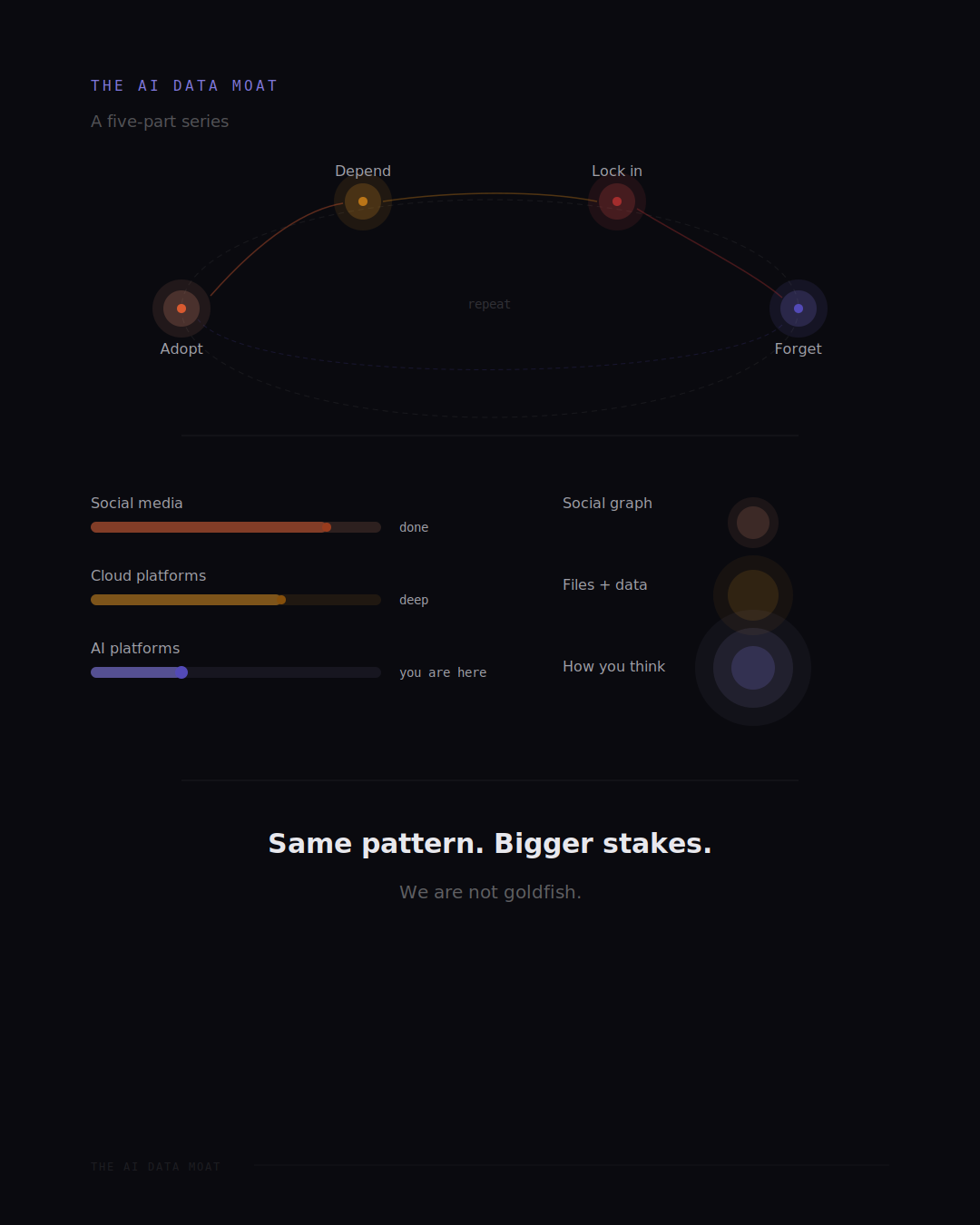
That thought stopped me. Because I have heard it before. I heard it about Facebook in 2012. About Gmail in 2015. About AWS in 2019. Every time, the same feeling: this is too useful, too embedded, too much effort to leave. And every time, the platform eventually changed the deal.
The goldfish problem
We have the memory of a goldfish when it comes to technology platforms. Every cycle is the same. Something new arrives, it is useful, it feels like it is on our side. We adopt it fast, pour our data and routines into it, and then the terms shift. The experience gets worse. The platform starts serving itself more than us. By the time we notice, leaving is too expensive.
Facebook went from connecting friends to optimizing for ad engagement. Google Search went from the best tool on the internet to a page of ads with some results underneath. Cory Doctorow literally wrote the book on this last year. Attract users, accumulate their data, make leaving painful, extract value. Same pattern whether it is a social network, a cloud provider, or a ride-sharing app.
And now here we are with AI. Probably the most personal technology most of us have ever used. And we are not stopping to ask basic questions. Who owns the context these platforms are building about me? Can I take it with me if I leave? What happens when the pricing changes?
This is not a sceptic's take
I want to be clear: I use AI more than most people I know, and I have no plans to stop. I am not calling for regulation that slows things down. What I am calling for is memory. The kind that says: we have been here before, and last time we did not think about portability or data ownership until it was too late.
Sam Altman said it plainly late last year: future versions of ChatGPT will have "perfect, infinite memory." Every document, every conversation, every correction. That is a lock-in strategy dressed up as a product feature. The deeper that profile gets, the harder it is to leave. That is not a conspiracy. It is a business model. We should probably recognize it by now.
You can be impressed by the technology and still think clearly about what you are signing up for. Those two things are not in conflict.
What this series covers
Over the next five weeks, I am going to write about the data moat that AI platforms are building around their users. Not because I think AI is bad. Because I think we can do better than we did last time.
Part 1 looks at how the lock-in forms in practice. Part 2 traces the enshittification pattern from social media. Part 3 explains why AI lock-in is different from anything we have seen before. Part 4 covers how agentic commerce raises the stakes further. Part 5 is about what is actually within our control right now.
The AI data moat — a series in six parts
Intro (you are here) · Part 1: The AI data moat is being built around you →
We are not goldfish. We can remember what happened last time. The question is whether we will, before the same patterns take hold in a technology that knows us better than any platform ever has.