Last week I wrote about the data moat that AI platforms are building around their users. Every conversation deepens your context inside a single platform, and that context gets harder to walk away from. A few people messaged me to say they had not thought about it that way. Which is exactly the problem. We have watched this pattern play out three or four times in the past fifteen years, and we keep not thinking about it until the door is already closed.
This is the part where I trace the pattern.
The enshittification playbook
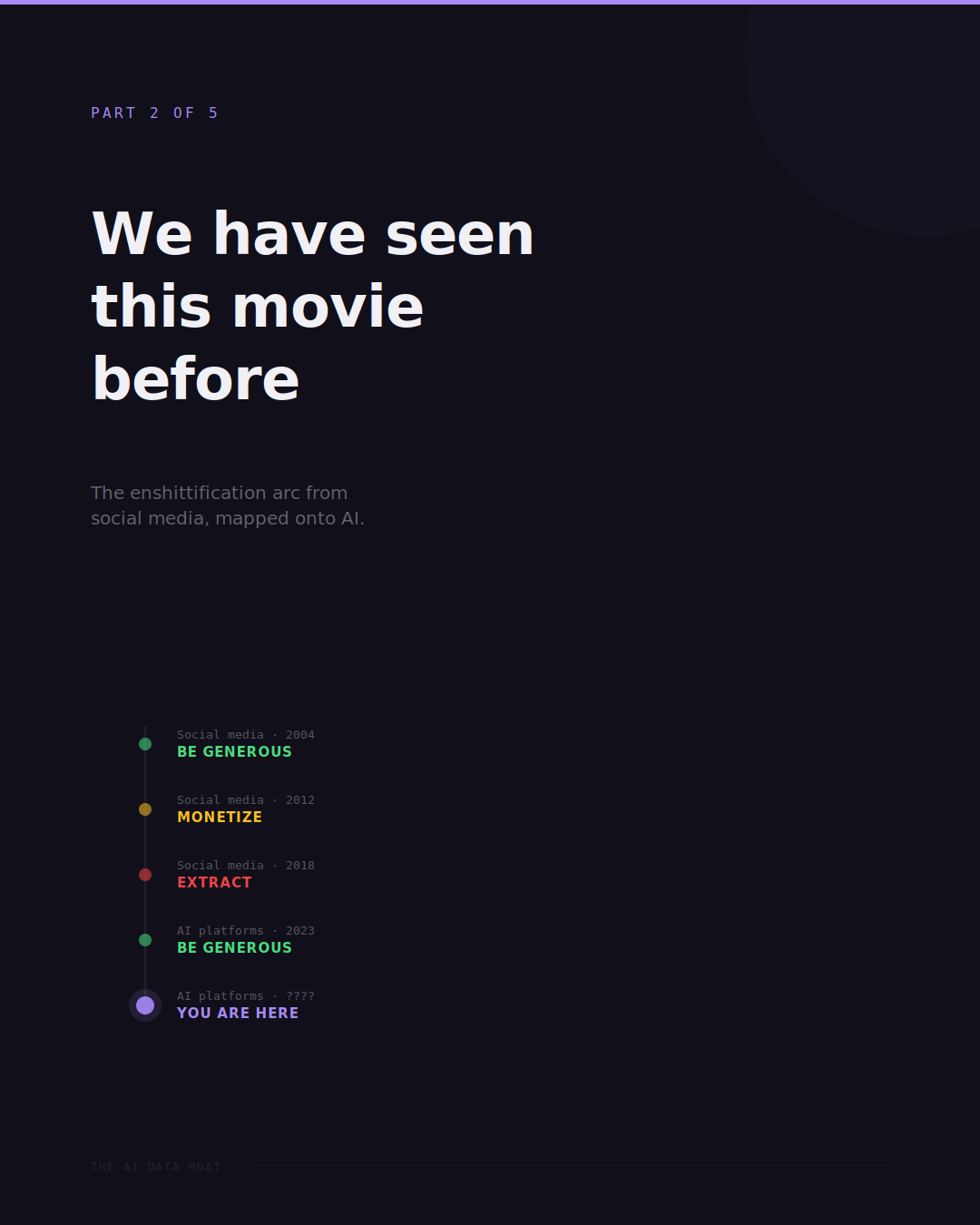
Cory Doctorow coined the term "enshittification" and then wrote an entire book about it last year. The mechanics are consistent across platforms: be good to users first, squeeze users to serve business customers second, squeeze everyone to serve shareholders third.
Facebook started as a genuinely useful way to stay connected with friends. Then the algorithm shifted toward engagement optimization, the feed filled with sponsored content, and organic reach for pages dropped to near zero. By the time the experience had visibly degraded, your social graph was too embedded to leave. Google Search went from clean, relevant results to a page where the first three or four items are ads and the rest are SEO-optimized content farms. Amazon started as a great place to buy things, then gradually shifted search results toward sponsored products and squeezed sellers with rising fees. Cloud providers offered transparent, affordable pricing, then introduced complex fee structures and egress charges that made leaving expensive.
The cycle always starts with generosity and ends with extraction, once the switching costs are high enough.
The AI version is already starting
We are watching the same playbook in AI, on a faster timeline.
The platforms are still in their generous phase. Free tiers, subsidized access, impressive capabilities shipped at speed. But running large language models is expensive. OpenAI, Anthropic, Google, and the rest are burning capital at rates that are not sustainable. The generosity has a shelf life.
The early signs are already showing. Perplexity is experimenting with ads in its search results. OpenAI restructured its pricing, moving features like model selection behind the $200-a-month Pro tier. Features that were free a year ago are now gated behind higher price points. This is not corporate greed. It is economics. But the direction is clear.
The more context a platform holds about you, the harder it is to leave when the experience starts to degrade. That is not an accident. It is the business model.
And here is the connection to the data moat from part 1. Attract users with a great experience, accumulate data that makes switching painful, then gradually shift value extraction toward the platform and its investors. The personal context your AI has built about you is the switching cost. It is the thing that keeps you from leaving when the ads arrive, when the pricing changes, when the quality of the free tier quietly declines.
Why AI enshittification could be harder to spot
With social media, at least the degradation was visible. You could see the ads multiplying in your feed. You could feel the algorithmic manipulation. You knew it was getting worse, even if leaving was inconvenient.
With AI, the degradation might be much harder to detect. If an assistant starts subtly favouring certain products in its recommendations, or adjusting its outputs to align with commercial partnerships, would you notice? If response quality on the free tier gradually declines to push you toward a paid plan, how would you even measure that? The conversational interface makes it far easier to embed commercial influence without clear labels. There is no "Sponsored" tag on a paragraph of advice.
The social media era gave us a vocabulary for these problems. Enshittification, dark patterns, algorithmic manipulation. We know what to look for now.
The AI data moat — a series in six parts
← Part 1: The AI data moat is being built around you · Part 2 (you are here) · Part 3: Your knowledge graph is the new lock-in →
The question is whether we will actually apply those lessons this time. Because right now, we are in the generous phase. And generous phases never last. Next week: why AI lock-in is not like social media lock-in at all, and why that makes it worse.