A colleague asked me last week whether he should consolidate all his AI usage onto one platform or keep splitting it across three. My immediate reaction was: consolidate, obviously. One platform with full context will always outperform three with fragments. Then I caught myself. That advice is exactly how the moat gets built. It is good advice for productivity and terrible advice for independence.
That tension is the core of this piece. The thing that makes AI useful is the same thing that makes it hard to leave.
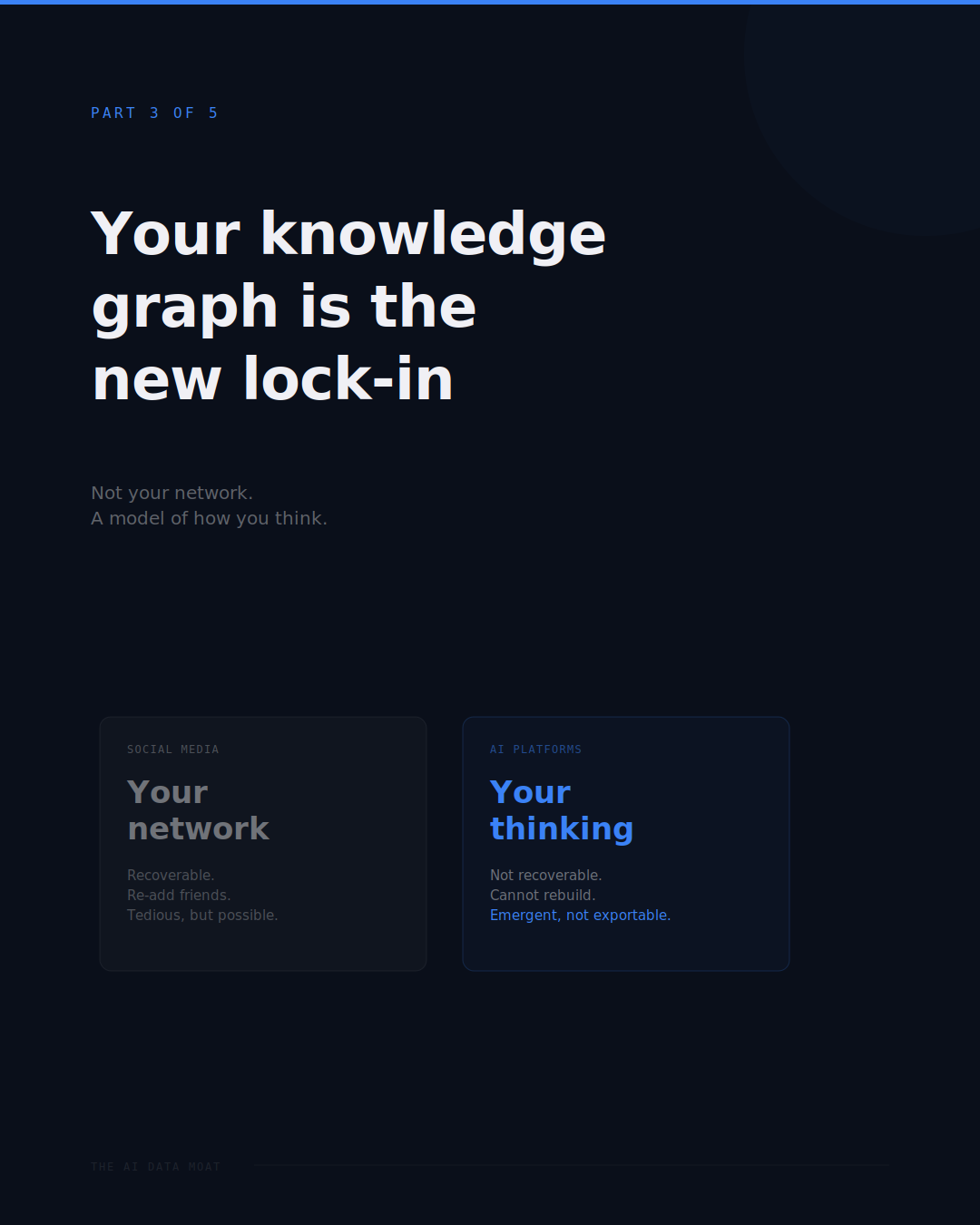
Social graph versus knowledge graph
In parts 1 and 2, I traced how the data moat forms and why the enshittification pattern from social media is already appearing in AI. But there is a reason the AI version of this deserves its own conversation. The lock-in works differently, and the difference matters.
With social media, the lock-in was about your network. Your friends were on Facebook, so you stayed. Your professional contacts were on LinkedIn, so you kept your profile updated. Moving was inconvenient, but the thing holding you in place was external. Other people, not you.
With AI, the lock-in is about you. Your preferences, your working style, your domain expertise as the system understands it. The context it has built across hundreds or thousands of interactions. And it lives inside platforms with no standard way to extract it.
A social graph is recoverable. You can re-add friends on a new platform, export a contact list. Tedious, but possible. The relationships exist independently of the platform.
A personal AI knowledge graph is not like that. It is a model of how you work, how you think, what you need. Shaped by every question, every correction, every preference you revealed without realizing it. That model does not export as a CSV. It does not reconstruct from memory. It is emergent, built through interaction, and locked inside the platform that created it.
The invisible accumulation
The tricky part is that nobody decides on day one to hand their cognitive profile to a platform. It happens conversation by conversation, correction by correction. Each interaction feels harmless. But the cumulative effect is a detailed model of your professional life that you did not consciously choose to create.
With cloud, you know what data you have stored. With AI, the most valuable thing is the pattern recognition the system has developed about you across all your conversations. That is much harder to define, let alone transfer.
Compare that to other forms of lock-in. With cloud providers, you can at least inventory your data and plan a migration. With productivity software, your files are discrete objects you can export. With AI, the valuable asset is not any individual conversation. It is the understanding the system has developed about you across all of them. Try putting that in a zip file.
What this means for how we adopt AI
None of this means we should avoid AI tools. The productivity gains are real. I get more done in a day with AI than I used to get done in three. But it does mean we should be deliberate about how we adopt them.
Every time you invest deep context in a single AI platform, you are betting that the platform will keep serving your interests, that pricing stays acceptable, that quality holds, and that the terms around your data will not change on you. That is a lot of trust for a single provider. Especially one that has not yet figured out how to be profitable.
The alternative is to start thinking about your personal AI context as something that should exist independently of any platform. Something portable. Something you own.
The AI data moat — a series in six parts
← Part 2: We have seen this movie before · Part 3 (you are here) · Part 4: Agentic commerce and the profile you did not know you were building →
Easier said than done today. But not impossible. And before we get to the solutions in part 5, there is one more dimension that raises the stakes even further: what happens when AI agents start spending your money. That is next week.