I tested an AI agent last month that booked a hotel for me. I gave it dates, a city, and a budget. It came back with three options, explained the trade-offs, and asked me to confirm. The whole thing took ninety seconds. I would normally spend an evening on that. I was impressed.
Then I thought about what it had just learned. Not just that I was travelling to that city on those dates. It learned my price sensitivity, that I prefer walkable locations over resort-style places, that I will pay more for a good breakfast but not for a gym. One booking. Ninety seconds. And already a richer profile of my preferences than any hotel loyalty programme has built in a decade.
What agentic commerce actually means
So far in this series, I have covered the data moat AI platforms are building, the enshittification pattern from social media, and why AI lock-in captures your knowledge graph rather than your social graph. But agentic commerce takes the stakes to a different level.
The idea is straightforward: instead of you browsing, comparing, and buying, an AI agent does it. Books travel, orders groceries, finds insurance, manages subscriptions. For anyone who has lost an evening to comparison shopping, this is a real improvement. And it probably will be a net positive for most people most of the time.
I am not being cynical. AI agents that negotiate better rates on your utilities or find flight options in seconds are solving real problems. The technology is impressive and the convenience is genuine.
But think about the data profile that creates.
From conversations to economic identity
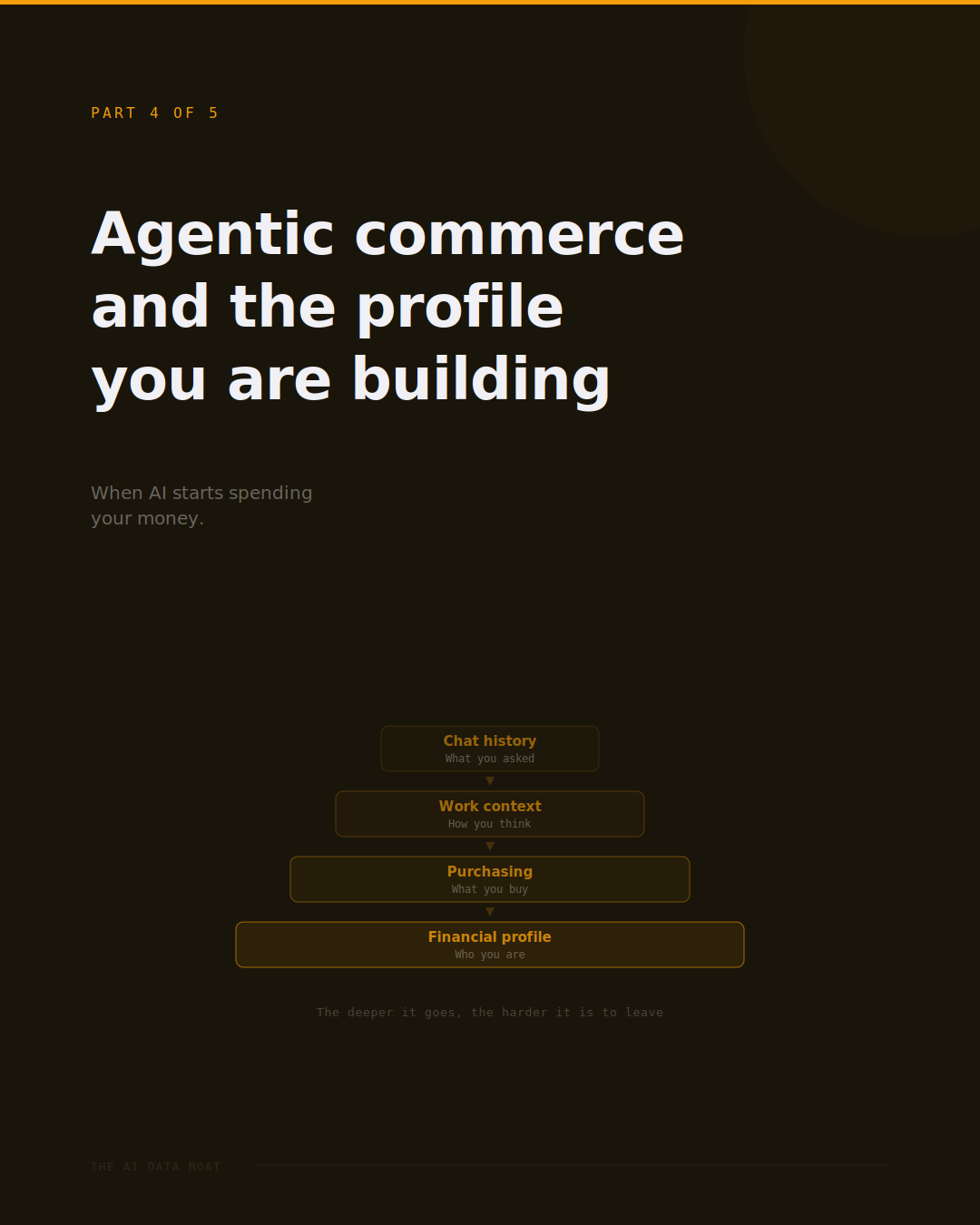
An AI agent acting on your behalf learns what you buy, how much you spend, what trade-offs you accept, what you are willing to pay more for, and what makes you hesitate. Over time it builds a picture of your financial patterns, your health priorities based on what you order, your lifestyle based on where you travel. That goes well beyond conversation history.
Today, fragments of this data sit across your bank, your supermarket loyalty card, your airline account, your streaming services. No single entity has the full picture. Agentic commerce changes that. One AI agent managing multiple aspects of your purchasing life holds a more complete profile of your economic behaviour than any platform has ever had.
The data moat is no longer just about how you think. It is about how you spend, what you value, and what you will tolerate. That is a profile worth billions.
The incentive question
There is a subtlety here that most coverage misses. These agents will almost certainly have commercial relationships with merchants and service providers. That is not automatically a problem. Affiliate models can work well when they are transparent. Recommendations based on actual relevance are valuable for everyone.
But if the incentive structures are hidden, the agent ends up optimizing for the platform's margin rather than your best outcome. Not because anyone set out to deceive, but because that is where the economics naturally pull. We have seen this play out in insurance comparison sites, hotel booking platforms, financial product aggregators. The agent framing is new. The incentive problem is very old.
Google, Amazon, Apple, OpenAI are all positioning to become the agent layer between consumers and commerce. Some will build trustworthy products. But the concentration of that much personal and financial data in platforms that also control the purchasing funnel deserves more scrutiny than it is getting.
Why this connects to everything else
This is where the portability conversation from the earlier parts gets urgent. When AI lock-in was about chat history, the stakes were convenience. When it extends to purchasing behaviour and financial patterns, the stakes are autonomy.
It is not just about switching AI providers anymore. It is about making sure your spending patterns and decision-making profile do not get permanently locked into one ecosystem with no exit.
The AI data moat — a series in six parts
← Part 3: Your knowledge graph is the new lock-in · Part 4 (you are here) · Part 5: Own your AI profile before someone else does →
The opportunity is real. Agentic commerce could save people enormous amounts of time and money. But so could social media have remained a useful connective tool if we had built in safeguards early enough. The lesson from every part of this series is the same: the time to shape the terms is while the technology is still being designed. Next week, the final part: what we can actually do about all of this.